
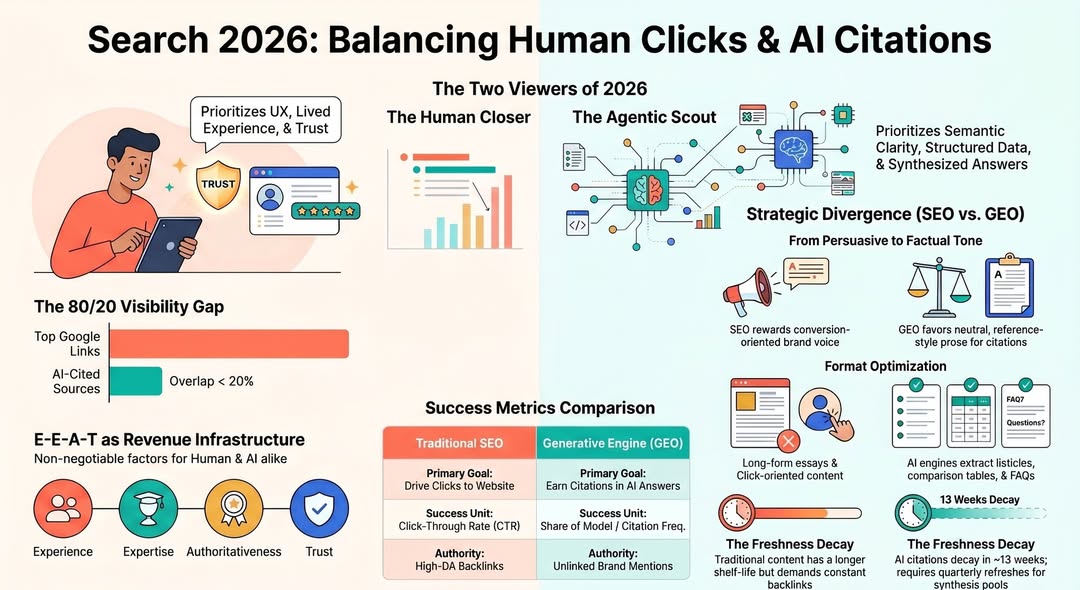
AI search is changing how content gets discovered. In the old search model, the goal was simple: rank higher, get the click, and let the reader decide. In the AI search model, your content may be summarized, compared, extracted, or cited inside an answer before the user ever visits your page.
That means visibility is no longer only about ranking. It is also about whether an AI system understands your content clearly enough to use it as a source.
The content that earns AI citations in 2026 usually has three things in common: it gives direct answers, supports claims with clear evidence, and makes the topic easy for machines to understand.
Why AI citations matter in 2026
AI citations matter because users are starting to get answers directly from AI tools, AI search engines, and AI-generated summaries. When your content is cited, your brand can appear inside the answer itself.
This is different from traditional SEO. In classic SEO, your page competes for a position on a search results page. In AI search, your content competes to become part of the answer.
That shift changes the way content should be written. A vague article with fluffy sections is harder for AI tools to extract. A clear, structured, source-backed article is easier to understand and cite.
AI search rewards content that is easy to understand, easy to verify, and easy to reuse inside an answer.
Characteristic 1: Direct answers that can be extracted
The first characteristic of AI-citable content is clarity. The article should answer the main question directly before adding extra context.
AI tools are not looking for mystery. They need clear passages that explain what something is, why it matters, how it works, and what the reader should do next.
Write the answer before the explanation
A strong section starts with a direct answer. Then it explains the details.
For example, instead of starting with a long introduction about how marketing has changed, write the answer first:
AI citations are references that AI search tools attach to generated answers when they use a webpage as a source.
That kind of sentence is easier for both humans and AI systems to understand.
Use simple section structure
AI-citable content usually has clean sections. Each section should focus on one idea, not five ideas mixed together.
- Use clear H2 headings for major ideas.
- Use H3 headings for supporting points.
- Use short paragraphs instead of giant blocks of text.
- Use lists when the answer has steps, traits, tools, or examples.
The goal is not to make the article robotic. The goal is to make the article easy to scan, understand, and extract.
Characteristic 2: Evidence that makes the content trustworthy
The second characteristic is evidence. AI tools are more likely to trust content that gives them clear reasons to believe the information.
That does not mean every article needs to be academic. It means your claims should be supported by useful proof.
Use specific examples
Generic content is easy to ignore. Specific content is easier to cite.
Instead of writing, “AI can improve marketing,” explain how:
- AI can summarize customer reviews into objections.
- AI can turn product benefits into ad angles.
- AI can create email variations for different buyer segments.
- AI can help compare competitors and identify positioning gaps.
Specific examples make the content more useful and more credible.
Add original insight
AI tools already have access to thousands of generic articles. If your content repeats the same surface-level advice, it gives the AI fewer reasons to cite you.
Original insight can come from your own framework, your own examples, your own data, your own screenshots, your own process, or your own way of explaining a topic.
For example, instead of only saying “write better prompts,” explain your exact prompt structure, why it works, and when someone should use it.
Keep content updated
Freshness matters more in fast-moving AI topics. A page about AI tools, AI search, or prompt workflows can become outdated quickly.
If you want content to stay useful, update it when tools change, screenshots change, pricing changes, workflows change, or the search behavior changes.
Characteristic 3: Strong context signals
The third characteristic is context. AI systems need to understand what your content is about, who it is for, and how it connects to related topics.
This is where many websites fail. They publish random posts that are not connected to a clear topic cluster.
Make the topic obvious
Your title, intro, headings, examples, and conclusion should all support the same main topic.
If the article is about ChatGPT prompts for marketing, the page should clearly connect to:
- ChatGPT
- AI prompts
- Marketing workflows
- Campaign planning
- Content creation
- Business growth
That helps AI tools understand the page as part of a larger topic, not just a random article.
Build topic clusters
One article is useful. A connected content system is stronger.
For example, instead of publishing one article about ChatGPT prompts, you could build a cluster around:
- ChatGPT prompts for marketing
- ChatGPT prompts for email
- ChatGPT prompts for sales
- ChatGPT prompts for content creation
- ChatGPT prompts for small business owners
This makes your website easier to understand as an authority around AI prompts and business workflows.
Use consistent language
AI tools rely on patterns. If your website uses five different names for the same thing, it becomes harder to understand.
Use consistent names for your brand, products, categories, and topics. For example, if your brand is “Success Steps,” use that name consistently across articles, product pages, author boxes, and metadata.
How to format content for AI citations
The best format is simple: clear answers, useful structure, specific examples, and trustworthy context.
Here is a practical checklist:
- Answer the main question early.
- Use clear H2 and H3 headings.
- Keep paragraphs short.
- Add specific examples.
- Use lists for steps, frameworks, and comparisons.
- Include original insights or practical frameworks.
- Update the article when the topic changes.
- Connect the article to related posts on your site.
This does not replace SEO. It upgrades SEO for the AI search layer.
Final thoughts
Content that earns AI citations is not just optimized for keywords. It is optimized for understanding.
If your content is vague, outdated, thin, or hard to verify, AI tools have less reason to use it. But if your content is clear, structured, specific, and connected to a larger topic system, it becomes easier to cite.
The future of content is not about writing more. It is about making your best ideas easier for both humans and AI systems to understand.
Want better AI content systems?
Explore practical prompts, workflows, and AI systems built to help entrepreneurs create smarter content, improve visibility, and grow with less manual work.
Explore Products