★★★★★
“Before Tone Twin, AI always sounded generic. Now Claude writes course lessons and emails in my own voice, which makes creating new content dramatically faster.”

New chat, blank slate. Every correction you made yesterday is gone, so you explain your voice, your audience and your rules again. And again.
Tone Twin ends it in one sitting. Three files in one folder, and Claude reads all of them before it writes a single word.
I publish constantly. Posts, captions, product copy, community updates.
Claude could give me something technically correct in seconds.
It rarely sounded like me.
Generic hook. Structure too polished. Phrases I’d never use. It explained too much and flattened the energy that made the original work.
So I’d ask for a post, get a draft, and start the loop:
Several rounds. Every time.
Claude was generating words. It wasn’t removing the work. I was still translating every draft back into my own voice before anything could go out. At 120,000 members, publishing every day, that isn’t a small tax. That’s most of the afternoon.
So I made the prompts longer. Who I am. What Success Steps does. The audience. The tone. The structure. The phrases to avoid.
Sometimes the prompt was longer than the post I was asking for.
Then I saved them in documents. One file for my tone. One for my audience. One for the phrases I hated. Now I had to find the right file, paste it, update it, and still fix the output afterward.
Nothing worked together.
Every new chat started from zero.
I’m an engineer. When something breaks this consistently, the problem is the structure, not the effort.
I’d learned that once already, building Success Steps. More tactics never fixed anything. A system did.
My prompts didn’t need to be longer. Prompts were the wrong place to keep something Claude needed every single time.
So I moved it out of the chat and into files.
The first test was simple. I asked Claude for an Instagram caption announcing a milestone. I didn’t say which milestone, didn’t re-explain my audience, didn’t paste a tone prompt. I told it to use what it already knew and not to ask me anything.
It picked the right milestone. It knew why that milestone mattered. It structured the caption the way I would have, and skipped the phrases I normally strip out by hand.
That’s when I stopped.
It wasn’t perfect. It still needed polish.
But for the first time I was editing a draft that already sounded like me, instead of rewriting a generic one into my voice.
I didn’t need a better prompt. I needed Claude to start every task already knowing who I was.
That became Tone Twin.
Prompting means starting from zero every time. Operating means Claude already has everything it needs before you ask for anything.
Every time you type the same context twice, that context belongs in a file, not a chat.
No app, no subscription, no plugin. Plain text files on your own computer that Claude reads automatically. Click through them.
Claude reads every file in ABOUT ME before every task — automatically. It only opens the other two when you point at them.
# ABOUT ME
## Who I am
I run a 120k-member AI community. I sell digital products to solo operators who publish weekly.
## My quality bar
Real numbers over adjectives. If a line can be cut, cut it.
## My voice tells
Short line. Then a longer one that earns its length.
# WRITING RULES
## Banned vocabulary
delve · leverage · unlock · seamless · elevate · game-changer
## The contrast trap (hard ban)
✗ "This isn't X. It's Y."
✓ Just state the positive claim.
## Formatting
No em dashes. Short paragraphs. Digits for numbers.
# MY WORK
## Goals
Newsletter 4.5k → 10k. Grow product income. Facebook stays priority one.
## Focus right now
One flagship launch this quarter. Nothing else ships.
## Saying no to
Short-form video. Client work. New platforms.
Plain .md text files in a folder you create. Nothing is stored in a product you have to keep paying for.
One block of Global Instructions, pasted once, tells Cowork to open ABOUT ME/ before every task.
Switch to ChatGPT, Gemini or Grok and paste the same three files in. Your voice isn’t locked to one platform.
Hire a VA or a ghostwriter and hand them the same folder. Now they can write as you too.
Work through the phases in order your first time. Each one sets up the next, and you can split them across as many sittings as you like.
No content yet. This phase is pure setup and it’s mostly clicking.
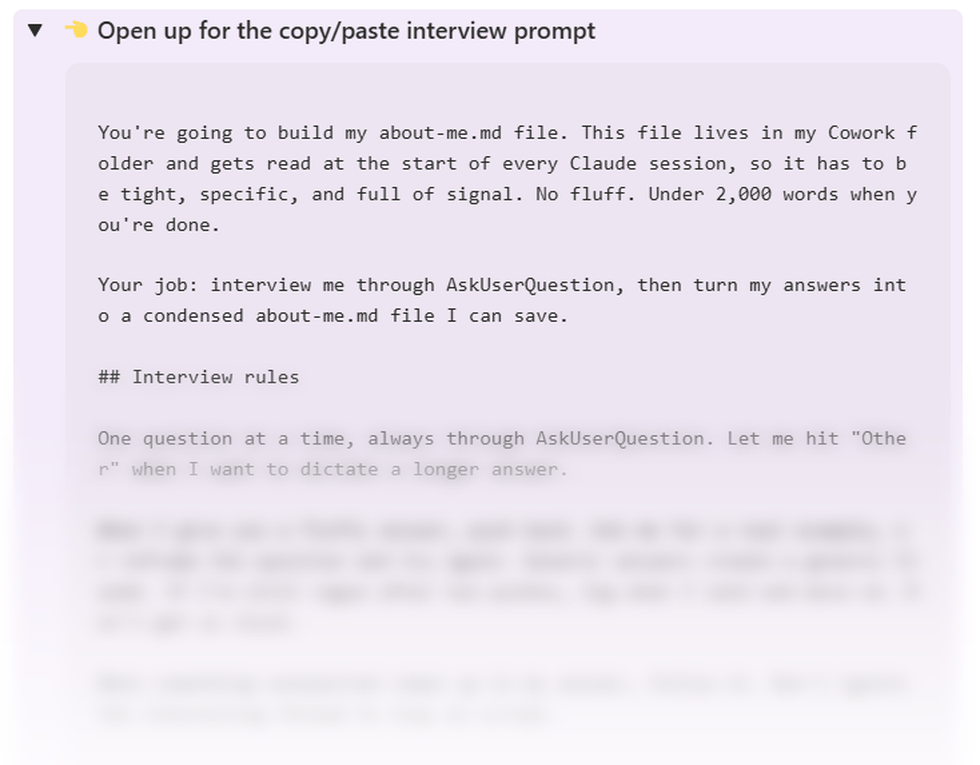
The part that actually matters. You paste one prompt and answer questions about your own work.
about-me.md and my-work.md and saves them for youClose everything, open a fresh session, and give Claude one prompt with no context at all.
Everything after this is optional sharpening. The setup itself is finished and it doesn’t need redoing.
Once the files exist, prompting stops being a skill you practise. It becomes four short commands.
That’s the whole prompt. Claude already knows your voice, your audience, your formatting rules and what you’d never write.
Claude comes back with a multiple-choice form instead of a guess. This is what kills the 5-rewrite loop.
Claude re-reads your rules, finds the AI tells it just produced, and rewrites them. An AI catching its own patterns.
Every piece you love becomes a reusable skeleton. Your best work turns into a library without any admin.
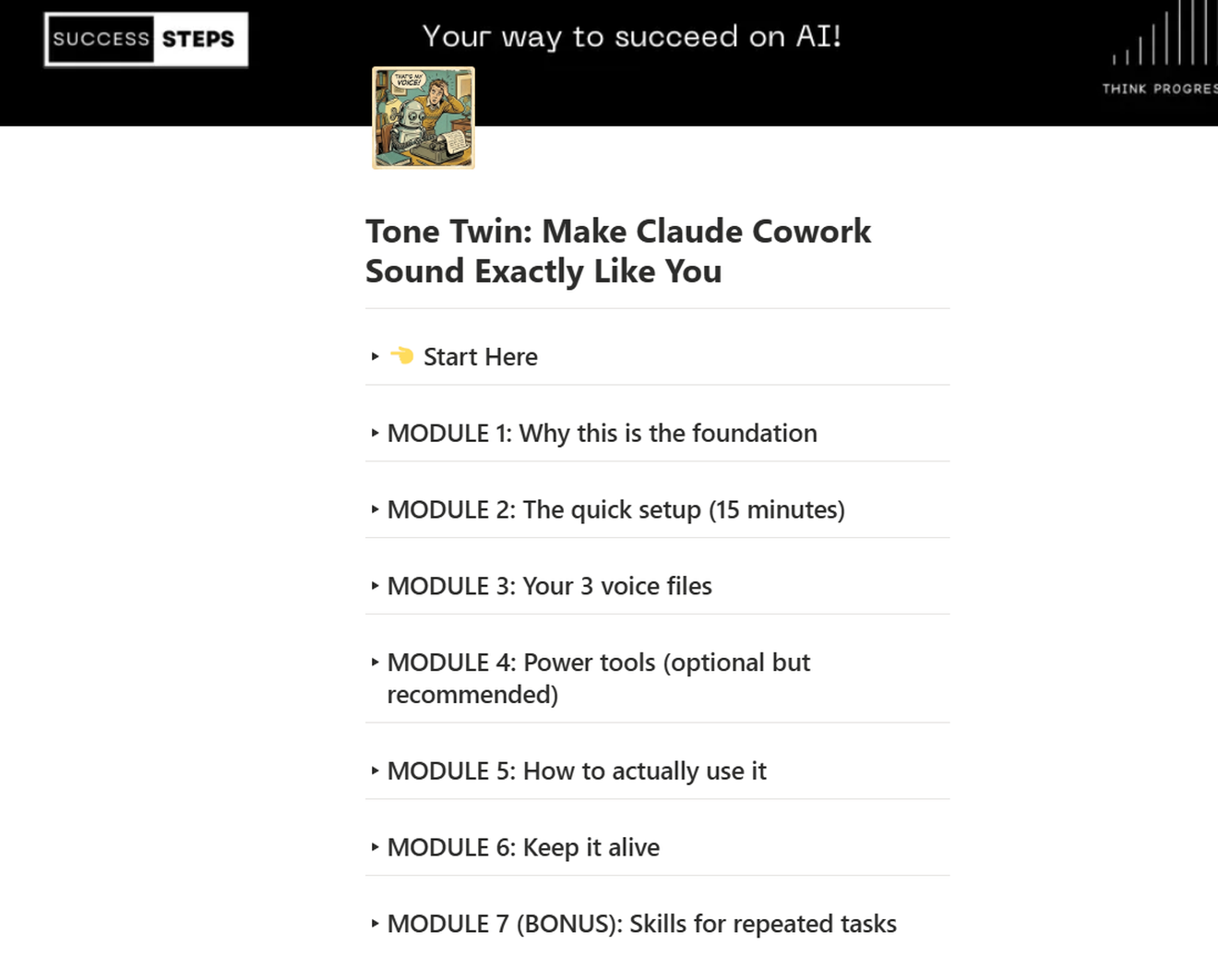
Built as toggles in Notion so you can skim it or work through it. Every prompt is a copy-paste block, every module ends in a checklist.
The shift from prompting to operating, what you’re actually building, and what changes the day after.
Desktop app, model choice, folder structure, and the Global Instructions block ready to paste.
The full interview prompts, the complete anti-slop style file, and the test that proves it worked.
Two free apps: one makes answering the interview 4x faster, one makes editing your files painless.
The four daily commands, the template library, and five habits that stop you hitting usage limits.
Update files not chats, the 3-month review, and the exact wording that makes a rule stick permanently.
Turn the tasks you repeat into slash commands. Type /linkedin and Claude knows the structure and your voice.
Open it next to the Claude app and work down the page. Duplicate it to your own Notion if you want the checkboxes to tick.
For people who publish every week and are done sounding like everybody else’s AI.

Build the three files tonight. Every Claude session from tomorrow morning starts out already sounding like you.
One-time payment Instant access Lifetime updates
Get Instant Access for $27 Delivered instantly via Notion
Creators, founders, agencies and marketers running Tone Twin so their Claude drafts sound like them from the first line.
“Before Tone Twin, AI always sounded generic. Now Claude writes course lessons and emails in my own voice, which makes creating new content dramatically faster.”
“My editing time dropped almost immediately.”

“I’ve spent years developing my newsletter voice. Tone Twin helped Claude learn those patterns almost perfectly. The drafts now feel like something I would’ve written myself, which makes publishing consistently so much easier.”

“One of the smartest AI purchases we’ve made.”
“Tone Twin finally made Claude sound like me instead of another AI. It has completely changed how I create client content.”

“As a startup founder, I don’t have time to rewrite every AI draft. Tone Twin changed that completely. Claude now produces investor updates, customer emails, and social posts that genuinely sound like they came directly from me.”
“We now use Tone Twin across our entire agency.”

“Tone Twin made our product descriptions and emails feel much more authentic while cutting our writing time in half.”
“As a social media manager, consistency is everything. Tone Twin lets me train Claude to write naturally in my own style, giving me stronger first drafts and reducing editing time across every client account.”

“Tone Twin transformed Claude into a true extension of my own writing process.”
“I’ve tried dozens of AI tools, but Tone Twin is the first one that captured my personality instead of producing generic content.”
“I recommend Tone Twin to clients because it helps AI sound authentic instead of robotic.”
“Before Tone Twin, AI always sounded generic. Now Claude writes course lessons and emails in my own voice, which makes creating new content dramatically faster.”
“My editing time dropped almost immediately.”
“I’ve spent years developing my newsletter voice. Tone Twin helped Claude learn those patterns almost perfectly. The drafts now feel like something I would’ve written myself, which makes publishing consistently so much easier.”
“One of the smartest AI purchases we’ve made.”
“Tone Twin finally made Claude sound like me instead of another AI. It has completely changed how I create client content.”
“As a startup founder, I don’t have time to rewrite every AI draft. Tone Twin changed that completely. Claude now produces investor updates, customer emails, and social posts that genuinely sound like they came directly from me.”
“We now use Tone Twin across our entire agency.”
“Tone Twin made our product descriptions and emails feel much more authentic while cutting our writing time in half.”
“As a social media manager, consistency is everything. Tone Twin lets me train Claude to write naturally in my own style, giving me stronger first drafts and reducing editing time across every client account.”
“Tone Twin transformed Claude into a true extension of my own writing process.”
“I’ve tried dozens of AI tools, but Tone Twin is the first one that captured my personality instead of producing generic content.”
“I recommend Tone Twin to clients because it helps AI sound authentic instead of robotic.”
No. You create a folder, add three subfolders, and paste one block of text into a settings box. Claude writes the three files itself by interviewing you. You only answer questions about your own work.
The Claude desktop app on Mac, Windows or Linux, and a Claude Pro plan at $20/month paid directly to Anthropic. Cowork only exists in the desktop app. The $20 plan is enough, so you don’t need the higher tiers to run this.
About two hours, and you can split it. Setup is 15 minutes. The interview that builds your voice files is 60 to 90 minutes, because that’s the part worth doing properly. Everything after that is optional.
They stack. Slop Killer is about what to remove: the banned words, the fake-insight patterns, each model’s tells. Tone Twin is about what to install: the folder, the files, and the setup that makes Claude write as you by default. Tone Twin ships with its own starter anti-slop file, so it works on its own.
You can, once per chat, every chat, forever, and you’ll still be guessing at what to include. The files make it permanent and complete. Claude reads all three before every task without being asked, and a correction you write today still applies next month.
The automatic part is Cowork specific. The three files are plain text, so you can paste them into ChatGPT, Gemini or Grok and get most of the benefit there too. Your voice profile isn’t locked to one platform.
Module 6 covers exactly that. You edit the file instead of correcting Claude in a chat, and there’s a 30-minute review to run every three months. A voice file that’s 18 months old stops sounding like you.
Email support within 7 days for a full refund. Run Module 2 and the test in Module 3 first. That’s about 20 minutes and it’s usually enough to know.
Two hours now. Every session after it opens already knowing who you are.
Get Your Tone TwinBrand new to Claude? Start with the free Claude Mastery Guide and come back once you’re set up.